

Vitalacy, Inc.

Author name: Vitalacy Team

Vitalacy is committed to reducing patient harm in healthcare through better hand hygiene and patient safety solutions. Bluetooth-enabled smart sensors and wearables help improve outcomes and Leapfrog Hospital Safety Grades.

Three Nurses Washing Hands at Hospital Sink

Why Effective Hand Hygiene Needs Both Soap, Water, and Sanitizer

A recent Centers for Disease Control and Prevention study about drug-resistant germs (CDC, 2019) continuing to pose a threat to patient safety renewed the Vitalacy team’s attention to a 2018 study specifically related to hand hygiene. “Increasing tolerance of hospital Enterococcus faecium to handwash alcohols” (Pidot et al., 2018) presents data showing that infections caused […]

Why Effective Hand Hygiene Needs Both Soap, Water, and Sanitizer Read More »

"Magnet Recognized" emblem by the American Nurses Credentialing Center with a blurred background of nursing credentials.

Gathering Evidence for Magnet Recognition in Your Nursing Program

Building Magnet Recognition in Nursing Programs The Magnet Model is the next generation Magnet Recognition Program from the American Nurses Credentialing Center (ANCC). While providing a framework for nursing practice and research, the model serves as a roadmap for healthcare organizations seeking to achieve Magnet recognition – a measure of the strength and quality of

Gathering Evidence for Magnet Recognition in Your Nursing Program Read More »

Healthcare worker tending to a patient at the bedside, emphasizing patient care.

Survey: Healthcare Workers Urge Leaders to Invest in Patient Safety

I noticed a commentary published in Modern Healthcare (2019) by Ann Marie Benedicto, the vice president of the Joint Commission Center for Transforming Healthcare. She writes that the center found in a recent survey that nearly eight of 10 healthcare professionals cited a lack of leadership (77 percent) and absence of organizational investment (79 percent)

Survey: Healthcare Workers Urge Leaders to Invest in Patient Safety Read More »

Vitalacy Blog - What Do Health Care and Sports Have in Common? Workflow Improvement Wins

Health Care Meets Sports: The Power of Workflow Improvement

Health care and sports have more in common than you might think, especially in regard to performance and workflow improvement. Improving performance in both depends on analyzing the movements and locations of your team members and making adjustments to achieve better outcomes, whether those outcomes are victories in games or reduced adverse events in health

Health Care Meets Sports: The Power of Workflow Improvement Read More »

Healthcare professional using a laptop in a medical setting, reviewing patient data.

Face Time vs. Screen Time: Has Tech Gone Too Far for Clinicians?

My wife was hospitalized recently and, while spending time with her, I couldn’t help but notice how much time the nurses and doctors spent looking at their computer screens. I know hospital leaders are looking for ways to reduce the time clinicians spend on technology-related tasks, but seeing nurses absorbed in computer work when I

Face Time vs. Screen Time: Has Tech Gone Too Far for Clinicians? Read More »

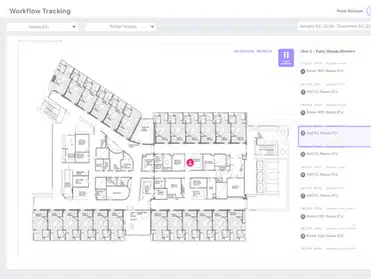
Digital workflow tracking map showcasing the layout of a medical facility and tracking a specific nurse's movement.

4 a.m.—Do You Know Where Your Nurses Are? Workflow Tech Can Help

Understanding the real-time workflow patterns of your nurses is crucial toward achieving high reliability in health care. Through their movements during the course of each shift, nurses provide insights that can be used to improve patient safety and quality. New workflow monitoring technology can track their movements and engage their support in patient safety, quality

4 a.m.—Do You Know Where Your Nurses Are? Workflow Tech Can Help Read More »

Medical professionals conversing in a modern, sunlit hospital corridor with glass walls.

What Is Your Organization’s Approach to Patient Experience?

The best experience for a patient is to receive effective treatment without harm, and then to go home feeling better. In an effort to achieve this obviously important patient safety and quality goal more reliably, hospitals began hiring the first “chief patient experience officers”, or CXOs, about 10 years ago. Now, CXOs appear somewhat to

What Is Your Organization’s Approach to Patient Experience? Read More »

A group of engaged healthcare professionals in a discussion, wearing scrubs and stethoscopes.

Reducing Burnout by Engaging Staff in Patient Safety Efforts

Witnessing the harm or death of a patient caused by a medical error can be a traumatizing event to a healthcare worker. Unfortunately, the impact of adverse events on caregivers often goes unnoticed. While the focus of efforts to enhance safety rightly centers on patients, workers involved in or exposed to adverse events also become

Reducing Burnout by Engaging Staff in Patient Safety Efforts Read More »

Illustration of a medical setting with a doctor monitoring a patient in a bed, a nurse walking by, and a hand holding a smartphone with medical alerts, all under a cloud symbolizing data storage.

Preventing Fatal Transfusions: How Frequent Monitoring Saves Lives

Monitoring Transfusions to Save Lives Many people choose the hospital they go to for care according to the hospital’s reputation. A patient in need of aggressive chemotherapy, for example, might base the decision according to the reputation of a hospital’s oncology division, or as part of a thought process that reasons, “If this hospital is

Preventing Fatal Transfusions: How Frequent Monitoring Saves Lives Read More »

Close-up of a healthcare worker's hands being washed under a faucet, with a wearable hand hygiene monitor on the wrist.

How to Improve the Accuracy of Your Hand Hygiene Compliance Data

Compliance with hand hygiene protocols has been linked to reduced healthcare-acquired infections (HAIs). For example, an academic medical center reduced the incidence of HAIs for two consecutive quarters after the center increased its hand hygiene compliance from 30 percent to more than 70 percent (Vitalacy, 2019). Being able to establish this link within your healthcare

How to Improve the Accuracy of Your Hand Hygiene Compliance Data Read More »

Scroll to Top