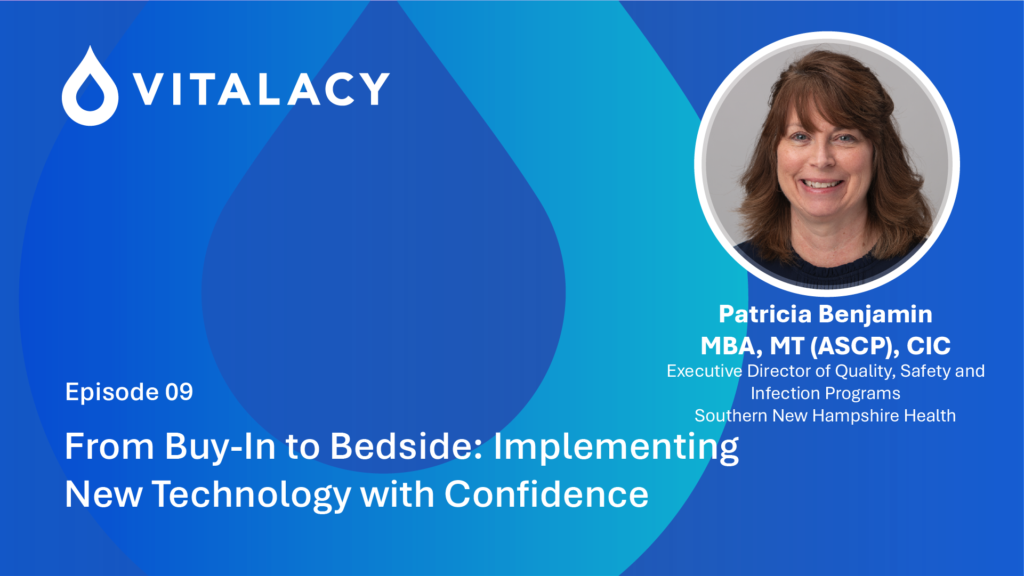

Most technology rollouts sound great on paper. Far fewer gain the traction needed for success. In our latest webinar, Patti Benjamin, MBA, MT (ASCP), CIC, is the Executive Director of Quality, Safety, and Infection Programs at Southern New Hampshire Health, shared her story of implementing Vitalacy’s Hand Hygiene Monitoring System, and how she moved beyond rollout to sustained improvement.
Step One: Getting Executives to Say Yes
Before any technology can go live, it has to survive the budget conversation. When Patti brought Vitalacy to her executive leadership team, she didn’t lead with the product — she led with the problem. Specifically, she started with regulatory requirements, pointing out that monitoring hand hygiene compliance is mandated, and that Southern New Hampshire Health‘s manual observation process was outdated and not producing useful data.
“If you look at our [manual observation] data over the past 7 years, our compliance was always at 95% to 100%... They started to understand: this data really is not valuable, because it's not showing anything.”
From there, she connected the dots to the many priorities executives are balancing: hospital-acquired infection rates, Leapfrog survey requirements, value-based purchasing measures, and CMS reimbursement. The technology stopped being an expense and started being an investment in outcomes the board was already tracking.
Her advice for others making a similar pitch: be transparent, clarify the “why” behind your solution, and walk in with a full plan — not just a request. “Don’t start the conversation and then lose it there. Take ownership of what you’re going to do with it going forward.”
The Hardest Part: Getting Frontline Staff on Board
With executive approval secured, Patti turned her focus to a more skeptical audience: the staff who would actually be wearing the Vitalacy SmartBadges every day to collect hand hygiene compliance. Their reaction was, in her words, “not good.”
Staff assumed the badge was monitoring everything they did — their movements, their conversations, their productivity. Resistance was immediate and vocal. Patti’s response was not to push harder, but to communicate more. The SmartBadge only monitored hand hygiene compliance when entering and exiting patient care areas. No monitoring breakrooms, no microphones, etc. Patti and her team attended huddles across shifts, held Q&A sessions, circulated FAQ sheets, and showed up in hallways to answer questions on the spot.
“Constant on-demand answering of questions, talking to people in the hallway, going to huddles at different times of day — and then explaining what we were going to do with the data, and how we could make some great changes with it.”
One decision that made a significant difference for Southern New Hampshire Health: keeping compliance data anonymous. Staff were assigned a badge by number only, not by name. Once employees understood that no one knew whose number was whose, anxiety dropped, and engagement climbed.
Reframing Resistance as a Cultural Opportunity
Some of the most useful moments in the rollout came disguised as complaints. When staff reached out to say the system wasn’t capturing their data, Patti and her team used it as an opening. They began shadowing staff workflow to show exactly where hand hygiene moments were being captured and missed. Those conversations exposed real workflow issues instead of technology issues. Skeptics became peer educators.
For the broader cultural question — what about staff who worry that monitoring creates a culture of fear? Patti had a reframe she used consistently:
“You’re doing hand hygiene every day. So let’s collect some data. Let’s show what a great job you are doing. Let’s celebrate that data.”
Keeping the Momentum: Gamification, Transparency, and Phased Rollout
Southern New Hampshire Health’s Infection Prevention team didn’t just turn on the system and wait for numbers to improve. They ran a sustained recognition campaign: every week for three months, they identified the top-performing badge number on each unit and presented a certificate at the morning huddle. Staff started competing for it. Then departments were added to the mix, and eventually a traveling trophy entered the picture. Higher hand hygiene compliance responded.
When compliance rates plateaued after approximately one year, the infection prevention and department managers implemented a strategic shift. In addition to reinforcing staff education on the rationale behind the approach, managers were granted access to badge-level data, enabling targeted one-on-one coaching conversations. This change resulted in an additional 10% increase in compliance.
The rollout itself was phased deliberately: first, education and awareness; then hand hygiene monitoring installation; finally, SmartBadge distribution. Each stage gave staff time to participate in the process before the next piece arrived.
If She Were Starting Over Tomorrow
When asked what she’d do differently, Patti’s answer was immediate: involve frontline staff as champions earlier, not just managers. The rollout relied heavily on directors and unit managers as the conduit to clinical staff, but peer voices — resource nurses, clinical educators — carry a different kind of credibility on the floor.
She’d also set clearer expectations from day one about exactly what problem the technology is solving, and why the manual process it replaces is inadequate. “Tell them this is labor-intensive. This will give you time to focus on patient care instead of trying to collect observations.”
PATTI’S TOP ADVICE FOR A SUCCESSFUL ROLLOUT
- Lead with outcomes, not technology. Frame your executive pitch around regulatory requirements, HAI reduction, and reimbursement — not features.
- Over-communicate with frontline staff.Show up at huddles, answer questions in the hallway, and keep going until anxiety turns into curiosity.
- Celebrate early and often. Recognition — certificates, trophies, huddle shoutouts — does more for compliance than monitoring alone ever will.
- Use complaints as coaching opportunities. When staff push back, follow them through their day. You’ll surface workflow gaps and create peer advocates.
- Phase the rollout. Give staff time to absorb each step before moving to the next. Less overwhelming, more sustainable.
The throughline across everything Patti shared was the same: communication and collaboration. Not as a soft nice-to-have, but as the operational strategy that made everything else work. “Transparency — this is what’s happening — communicate with all the proper stakeholders and get them all to collaborate with you to make it work.”
Want to see Vitalacy in action?
Learn how Southern New Hampshire Health improved hand hygiene compliance — and how your facility can too. Schedule a demo.
Author
-
View all postsVitalacy is committed to reducing patient harm in healthcare through better hand hygiene and patient safety solutions. Bluetooth-enabled smart sensors and wearables help improve outcomes and Leapfrog Hospital Safety Grades.