On August 16, Geisinger notified the public that a visitor with high suspicion of measles had been on the Geisinger Medical Center campus in Danville, Pennsylvania, from 1 p.m. on August 12 until 9 p.m. on August 13. Thirty-two hours, across five areas: the emergency department waiting room, the pediatric emergency department, the second floor of the children’s hospital, the atrium, and fluoroscopy.
Four days later, the Oregon Health Authority identified a Kaiser Permanente emergency department waiting room near Portland as a measles exposure site for a two-hour window.
Both organizations moved quickly and did the right thing, however, contact tracing by chart alone cannot tell a complete story, especially when the person to trace is not a patient or staff member.
The EMR only tells us who charted
When discussing contact tracing, this is the gap we hear described at nearly every infection prevention conference. The EMR record can be both incomplete and over-inclusive. Many entries leave no timestamped trace tied to when and where actual care was performed on the patient. It is frequently done hours later or even at the end of a shift due to heavy workloads. To fill the gap, most Infection Preventionists rely on interviews and memory to complete the investigations.
What that looks like in contact tracing
Cambridge Health Alliance, a 300-bed safety-net health system, audited a year of tuberculosis exposure investigations and presented the results at SHEA this spring. Seven patients with active pulmonary TB had potentially exposed nearly 250 staff across six clinical areas, requiring multiple rounds of notification despite prompt protocols.
Of 238 staff contacted, 87 turned out to meet the exposure definition. The initial list was stale enough to include people who no longer worked there. The authors named the barriers plainly: “incomplete exposure lists, fragmented interdepartmental communication, and inconsistent documentation.” They recommended centralized tracking.
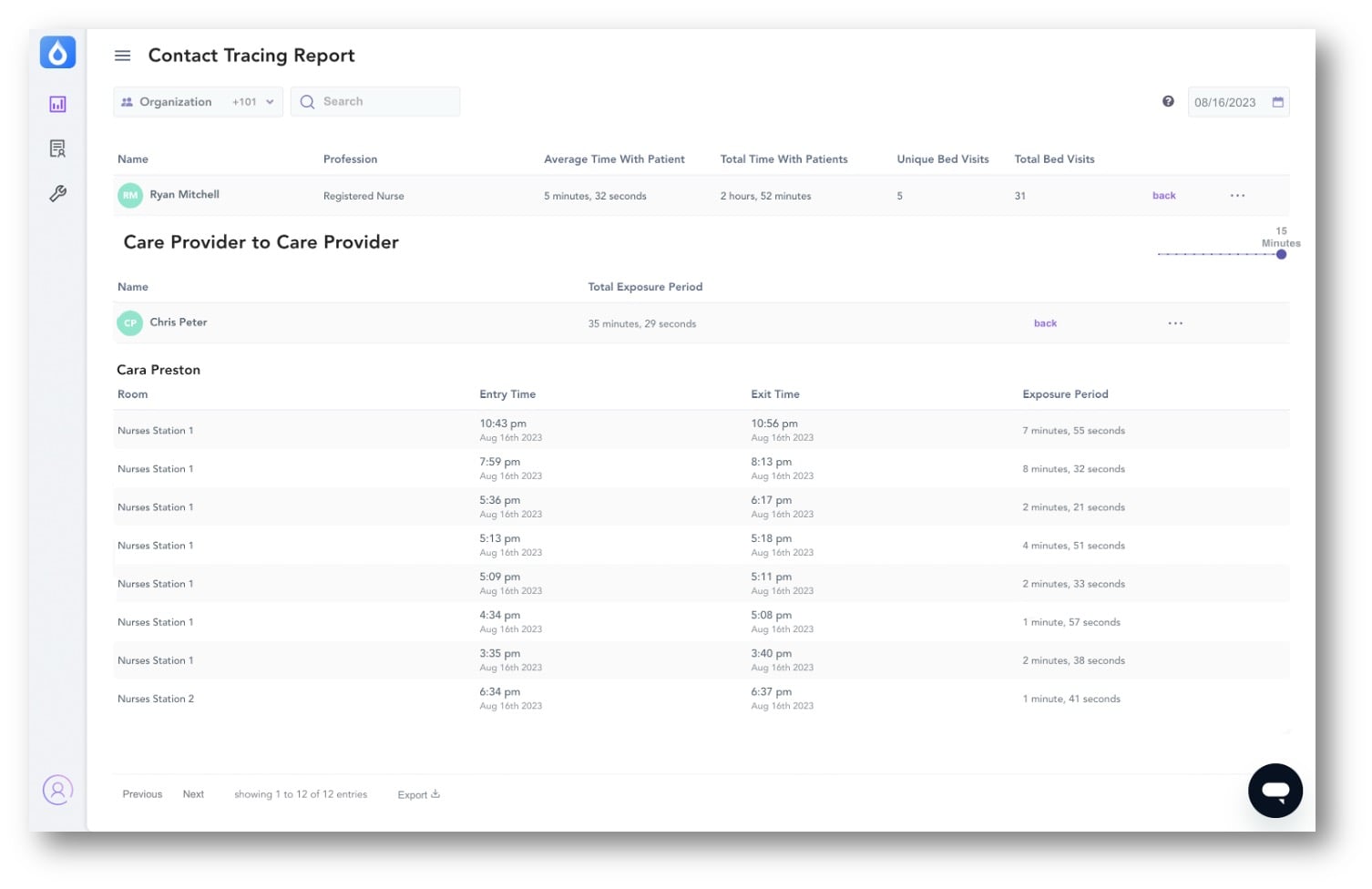
Note how they defined exposure: 15 minutes or more within 6 feet, unmasked. Not a binary presence question, but a duration threshold. That distinction turns out to matter a great deal.
A US study showed the value of location and duration. During a pertussis outbreak in an emergency department, adding location data doubled the exposure list compared with chart-based identification alone. It was also dramatically faster: location queries took under five minutes, against 30 to 60 minutes per chart review. Diseases like Measles PEP have narrow windows, and so does varicella. An investigation that takes three days to assemble a list has already lost the intervention.
Location data isn't a silver bullet
Anyone selling automated contact tracing as completely solving the problem is overselling it. For example; a staff member working in several locations at a hospital while their badge in a locker tells you nothing.
There’s also the difference between presence and proximity. Entering a single-occupancy isolation room reasonably implies close contact; standing in an open ED bay doesn’t necessarily. This is exactly why duration matters, and why Cambridge Health Alliance’s 15-minute threshold is the operational standard most programs work from. A system that records how long someone was present produces a very different list than one flagging every momentary detection. This is the threshold Vitalacy uses.
Combining resources performs the best. Automated data gets you a fast, defensible starting list. Verification with staff refines it. Not a replacement for judgment, just a better first draft.
Questions worth asking before your next investigation